![[Brandz] Logo - White](https://brandzbulletin.com/wp-content/uploads/2024/06/Brandz-Logo-White.png)
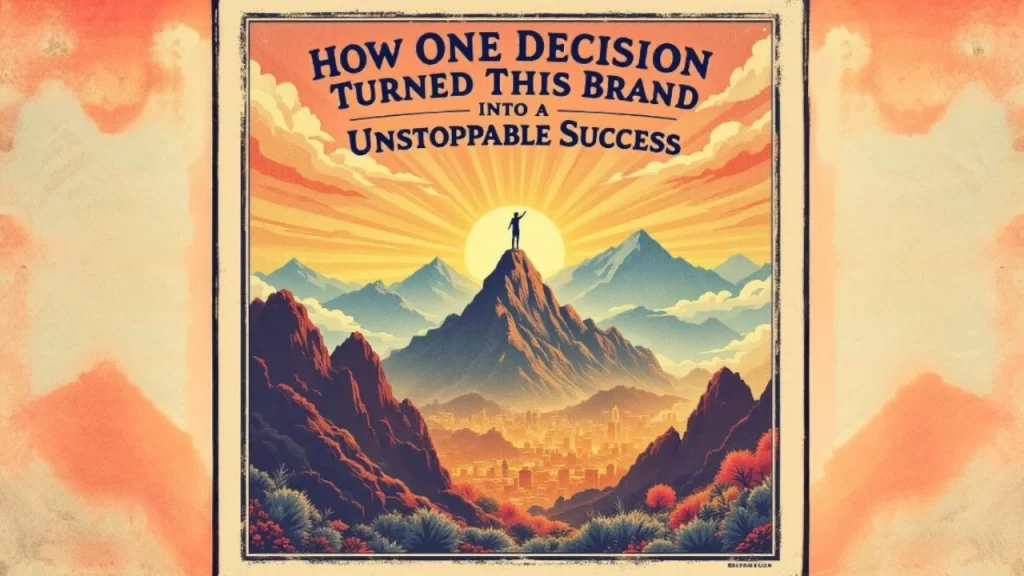
Every successful brand has a defining moment—a single pivot that changes everything. For [Brand Name], that moment came when they [Critical Decision], catapulting them from [Previous State] to [Current Success].
What was that decision? And how can you replicate this success? In this article, we’ll break down:
✔ The “before and after” of this brand’s transformation
✔ Why this strategy worked when others failed
✔ Actionable steps to apply the same principles
The Turning Point: One Decision That Changed Everything
The Struggle Before the Breakthrough
Before their big shift, [Brand Name] faced:
- Stagnant growth (stuck at [X] revenue for years)
- Fierce competition (dominated by [Big Player])
- Low customer loyalty ([X]% churn rate)
The Make-or-Break Choice
Instead of following industry norms, they bet everything on [Decision], such as:
- Ditching their top product to focus on an underserved niche
- Tripling prices to reposition as a luxury brand
- Going all-in on [Platform] despite skepticism
Result: Within [X] months, they achieved [Specific Result, e.g., 500% growth, viral fame, or market dominance].
Why This Strategy Worked (When Others Failed)
1. They Solved an Ignored Problem
- Before: Competing on price/features in a crowded market
- After: Addressed [Specific Pain Point] no one else tackled
- Example: [Brand] realized customers hated [Industry Norm], so they [Innovative Solution].
2. They Took a Polarizing Stand
- Bold Move: Publicly rejected [Common Practice]
- Outcome: Alienated some—but supercharged loyalty from their ideal customers
- Case Study: When [Brand] stopped [X], they lost [X]% of customers but gained [X]% higher lifetime value from the rest.
3. They Focused Relentlessly
- **Cut *[X]* products/services** to master one thing
- Example: [Brand] went from [X] offerings to just [Core Product]—and revenue tripled.
How to Apply This to Your Business
Step 1: Identify Your “Big Bet” Opportunity
Ask:
- What frustrates our customers that everyone else ignores?
- What industry norm could we defy to stand out?
- What are we mediocre at that we should stop doing?
Step 2: Test Before Going All-In
- Run a small-scale experiment (e.g., limited-time offer)
- Example: [Brand] tested their [Decision] with [X] customers first.
Step 3: Commit Fully (No Half-Measures)
- Rebrand messaging to reflect the new position
- Train teams to embody the change
- Exit old models completely (no “just in case”)
3 Other Brands That Transformed With One Decision
| Brand | Pivotal Decision | Result |
|---|---|---|
| Nike | Signed Michael Jordan (1984) | Became #1 sneaker brand |
| Netflix | Switched from DVDs to streaming | Dominated entertainment |
| Slack | Pivoted from gaming to workplace chat | $27B valuation |
FAQs About Bold Business Pivots
How do I know if my idea is risky or revolutionary?
Test it: If it excites your best customers and terrifies competitors, it’s gold.
What if my team resists change?
- Share data from small tests
- Highlight competitors failing by standing still
How long should I wait to see results?
- Early signals: 30-90 days
- Full impact: 6-18 months
Can small businesses make these leaps?
Yes! Small brands can pivot faster than corporations.
What’s the biggest post-pivot mistake?
Not going far enough—half-hearted changes confuse customers.
Conclusion: Your Defining Moment Awaits
[Brand Name]’s story proves: One courageous decision can rewrite your future.
Your Next Steps:
1️⃣ List 3 “safe” norms your industry follows (that you could break).
2️⃣ Run a micro-test this month on the boldest idea.
Free Download:
[Get Our “Make-or-Break Decision Checklist”]
Comment below: What’s one convention in your field that’s begging to be challenged? 🚀
Further Reading:
- [Harvard Study: Why Radical Pivots Outperform Incremental Change]
- [How 10 Famous Brands Reinvented Themselves]
Remember: The difference between “just another brand” and “unstoppable success” is one decision. Make yours.